The two styles clients ask about most sit at opposite ends of tattooing's range. American traditional is the oldest surviving school: bold black outlines, a tight palette of solid color, and images built to be read across a room and across forty years. Fine line is the modern counterpoint: hair-thin lines, minimal shading, small and quiet pieces that sit on the skin like pencil work. Both are specialties at shops like Family Tradition Tattoo in Mooresville, and both are excellent, for different people and different ideas.
Choosing between them is not a matter of which is better. It is a matter of which suits your design, your placement, and your expectations about how a tattoo ages. This guide compares them honestly, including the part fine line's popularity sometimes skips: what thin lines do over time, and how a good artist designs around it.
Where each style comes from and what it does best
American traditional grew up in port towns and military towns, tattooing sailors and soldiers who needed work done fast that would last a lifetime of sun and labor. Its rules are engineering as much as art: heavy outlines contain the color, solid packing survives fading, and simple bold shapes stay legible as skin changes. Eagles, roses, daggers, ships, and panthers are not just classic subjects; they are subjects that survive the format's constraints beautifully.
Fine line comes from a different lineage, single-needle work refined in Los Angeles and exploded by social media. It does what traditional cannot: tiny botanical sprigs, delicate script, miniature symbols, and soft black-and-gray pieces with almost no outline weight. On fresh skin it is exquisite. If your idea is small, subtle, and personal rather than bold and declarative, fine line is probably the language it wants to be spoken in.
The aging conversation, honestly
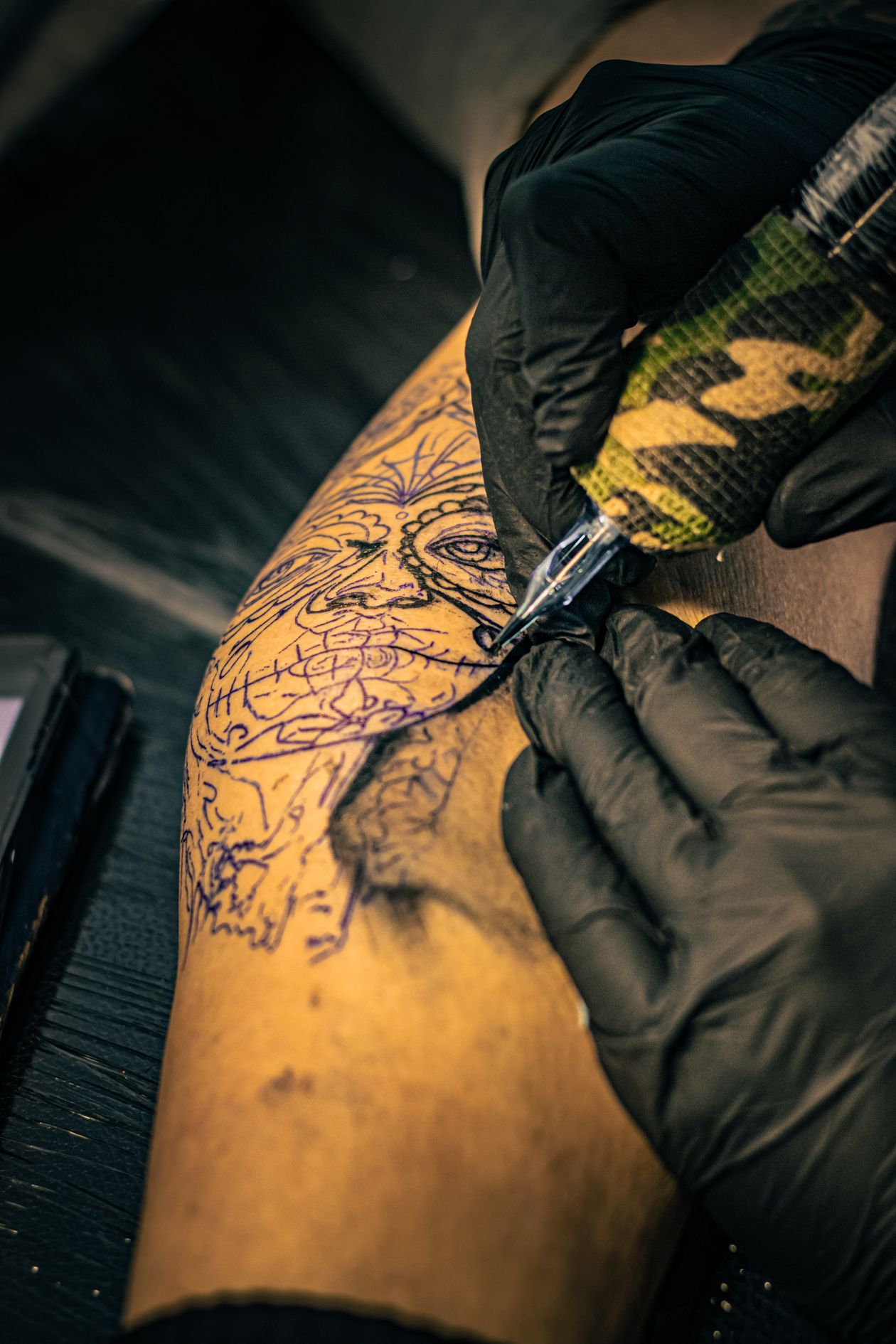
All tattoos age. Ink sits in skin that stretches, tans, and renews itself, and lines spread slightly over the years as the immune system nibbles at pigment particles. Bold traditional work plans for this: its lines start heavy and its shapes start simple, so a decade of softening leaves a tattoo that still reads instantly. The style was designed, by a century of practical iteration, to grow old gracefully.
Fine line work has less margin. A hair-thin line that spreads becomes a slightly less thin line, which is fine, but packed tiny detail can merge as it softens, and very light shading can fade faster than clients expect. Skilled fine line artists compensate: they simplify designs, space details generously, use enough contrast, and will tell you when an idea is too small for its detail. A design refused at your requested size is not an upsell; it is an artist protecting the ten-year version of your tattoo.
| Question | American traditional | Fine line |
|---|---|---|
| Line work | Bold, heavy outlines built to hold | Single-needle thin, delicate lines |
| Color | Solid, limited classic palette | Often black and gray, minimal or no color |
| Best sizes | Medium and larger, where boldness reads | Small to medium, detail kept simple |
| How it ages | Softens but stays legible for decades | Needs a skilled hand; fine detail can soften sooner |
| Classic subjects | Eagles, roses, daggers, pin-ups, anchors | Botanicals, script, small symbols, minimal figures |
Choosing for your idea and placement
Start with the idea's natural scale. A design that wants to be three inches of bold imagery is traditional's home ground; a design that wants to be a quiet two-inch sprig behind an ankle belongs to fine line. Consider placement next: fine line favors flatter, calmer skin, while traditional handles elbows, knees, and other high-movement, high-sun areas with its usual indifference. Consider your own temperament last. If a tattoo softening over the years would bother you, choose bold. If subtlety is the whole appeal and you accept maintenance, choose fine.
Plenty of clients end up with both, on different parts of the body, for different reasons, and hybrid work exists too: traditional shapes with slightly finer interior detail, or fine line pieces with firmer outlines than Instagram's lightest examples. Bring references for the feeling you want and let the consultation match style to idea. That matching, done honestly, is most of what you are paying an experienced artist for.
Common questions
Can any design be done in fine line if I keep it big enough?
Scaling up helps a great deal, since spacing detail out is the main protection against softening. Your artist may still simplify elements, but size is the single biggest lever.
Which style hurts less?
Neither meaningfully. Fine line uses smaller needle groupings and often involves less total work, so sessions are usually shorter, which most people experience as easier overall.
Can a faded fine line tattoo be reworked later?
Often, yes. Artists can strengthen lines and add contrast in a touch-up or rework session once the piece is fully healed, and traditional techniques can reinforce a softened design.
Photos in this guide are representative stock images.
← All guides from Family Tradition Tattoo← Back to Family Tradition Tattoo